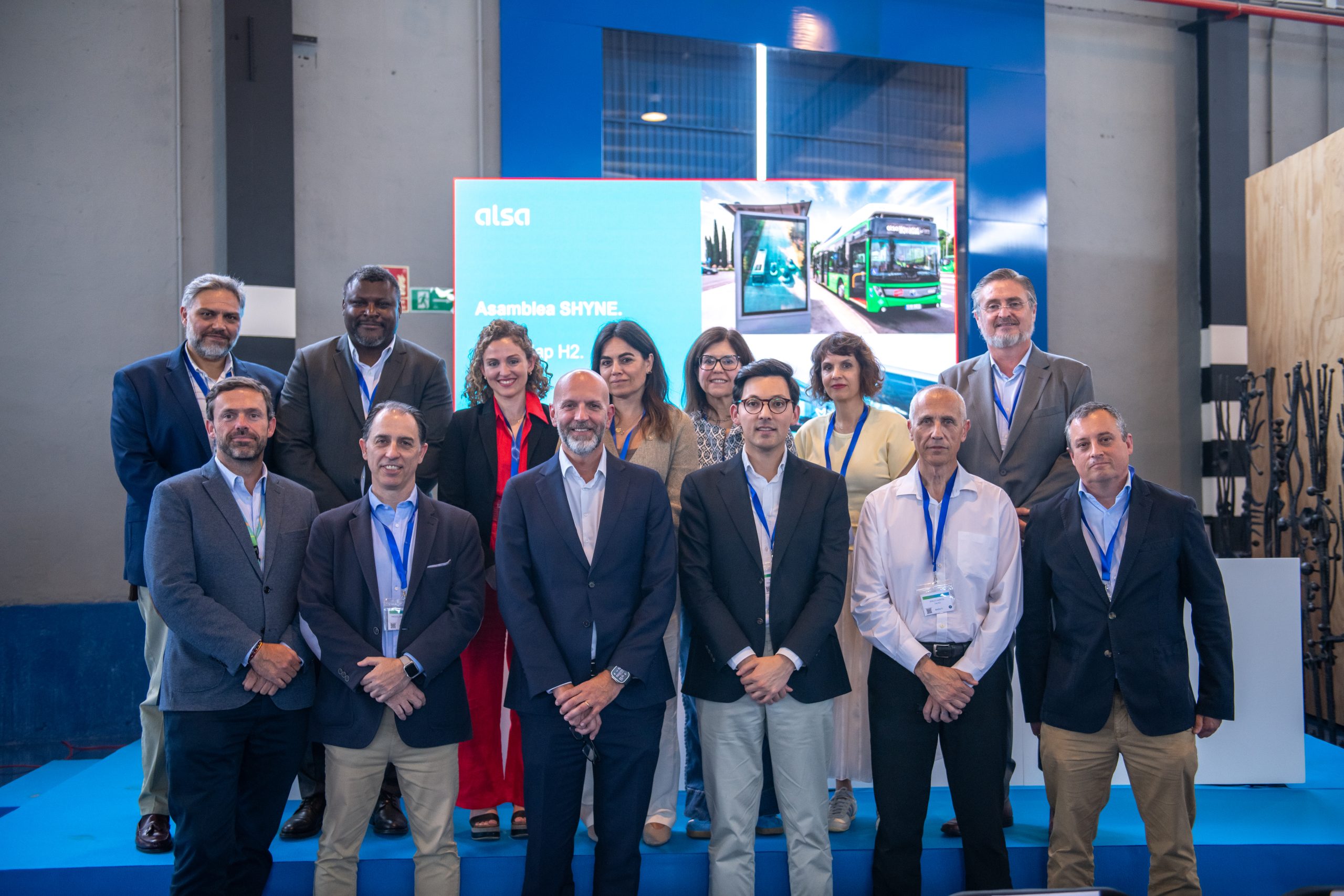
- The association is sponsored by seven major companies and comprised of more than 20 affiliates, including associations, universities, technology centers, and companies from various sectors.
- Its objectives include coordinating efforts among companies from various sectors to develop a robust infrastructure that supports the expected growing demand for renewable hydrogen and strengthens Spain's position as a leader in the production and use of renewable hydrogen.
- Public-private collaboration will be an essential driver for overcoming regulatory obstacles and ensuring that the sector develops at the pace required by the energy transition.
- During the event, the challenges and opportunities of this energy vector were addressed in two roundtable discussions moderated by journalist Marta Reyero, with representatives from Alsa, Bosch, Enagás, Enagás Renovable, Navantia Seanergies, Repsol, and Talgo.
- The event featured prominent institutional representatives: Joan Groizard, Secretary of State for Energy (in charge of closing the event); José Moisés, Director General of the CDTI (Center for Industrial Technological Development); José Manuel Prieto, Deputy Director General of Industrial Quality and Safety; and José Manuel Naharro, Technical Director of the Energy Foundation of the Community of Madrid.
Madrid, Wednesday, February 26, 2025.- SHYNE (Spanish Hydrogen Network) held an event today to formally present the association, which was recently established with the aim of leading the transformation toward a decarbonized and competitive economy by promoting renewable hydrogen-based projects.
Joan Groizard, Secretary of State for Energy, stated during the event's closing speech that "we are facing an industrial and technological challenge and opportunity in the use of renewable hydrogen, in its production, management, and transportation, which fits with the decarbonization-competitiveness paradigm. The energy sector is in a period of transition, with very tight deadlines, so we must be able to combine public-private collaboration and the private sector among competitors, clients, academia, and other institutions. Something that has been demonstrated today at this event." The Secretary of State for Energy also emphasized that "if we want to make this transformation a reality, we must have a continuous and constant push from the public administration, so that it continues to act as an incentive and lever for private investment, especially with a perspective of strategic autonomy. That's why, in the latest call for aid, for Hydrogen Valleys, endowed with 1.2 billion euros, the 91% of the selected projects relied on European stacks, membranes, electrodes, and component assembly, in response to one of the parameters we indicated in the call: the promotion of industrial resilience."
Javier Arboleda, CEO of SHYNE, who noted that "our mission is clear: to serve Spanish society. To achieve this, we will work closely with public administrations, promote financing for the sector, and foster the development of demand. We firmly believe in public-private cooperation as a lever for change."
Tomás Malango, president of SHYNE and director of Renewable Fuels and Circular Economy at Repsol, was responsible for closing the event. During his speech, he emphasized that "SHYNE's ambition is to be the leading promoter of renewable hydrogen projects in Spain, acting with a single voice that represents the value chain, accelerating its development, and helping to make the country a benchmark in energy transition and reindustrialization."
Spain is currently in a privileged position to lead the development of renewable hydrogen in Europe. The country has experienced significant growth in projects based on this energy source, and the Hydrogen Roadmap, established by the Ministry for Ecological Transition and the Demographic Challenge, places renewable hydrogen as one of the keys to achieving climate neutrality.
SHYNE was created specifically to make these projects a reality, with the help of seven major development companies with already tangible projects - Alsa, Bosch, Enagás, Enagás Renovable, Navantia Seanergies, Repsol and Talgo - and with the support of more than 20 affiliates, such as associations, technology centres, universities and companies from different sectors - air and maritime transport, steel, manufacturers of gas storage and distribution systems, electricity producers, engineering firms for electric mobility or for the design and processing of advanced materials.
Opportunities and challenges for a Country Project
Spain has the ideal conditions to make the renewable hydrogen economy a national project, one that responds to strategic autonomy and contributes to the decarbonization goals of Spain and the European Union. Speakers from the SHYNE sponsoring companies, representing all stages of the renewable hydrogen value chain: generation, storage, distribution, and consumption, discussed opportunities and challenges.
Among the key topics addressed, the important role of regulatory certainty and regulatory acceleration stands out first and foremost. Although the current legal framework is favorable to the development of renewable hydrogen, there is still room for improvement in streamlining administrative processes and creating regulations that facilitate project implementation. Initiatives such as the PERTE (Renewable Energy, Hydrogen, and Storage) have been key to promoting projects, but these mechanisms need to be strengthened and new support tools established to accelerate infrastructure deployment and the adoption of renewable hydrogen solutions. Public-private collaboration, therefore, is emerging as an essential driver for overcoming regulatory obstacles and ensuring that the sector develops at the pace required by the energy transition.
Furthermore, attention has also been drawn to the need for a hydrogen transport backbone that connects production with demand, not only domestically but also with third countries. An infrastructure that enables the efficient distribution of renewable hydrogen will be key to reducing costs and facilitating access to this energy source for consumers. This network would not only improve the sector's competitiveness but also optimize price formation.
Participants at the event emphasized that by investing in these levers, we will be contributing to the creation of a robust national industrial fabric and boosting the competitiveness of the green economy. Furthermore, it was emphasized that renewable hydrogen presents an opportunity to consolidate the leadership of both the Spanish and European industries in the face of international competition, especially given the uncertainty surrounding incentives for renewable energy in the US and China's push into the global clean technology market.
This energy vector can play a key role in moving toward a low-emissions economy, decarbonizing hard-to-electrify sectors such as heavy industry and long-distance transport, providing solutions and positive effects for society as a whole, such as contributing to the reduction of greenhouse gases, or generating quality employment in areas such as research, project development and maintenance, and the production and industrial use of renewable hydrogen.
The creation of SHYNE as an association allows for the coordination of efforts among companies from diverse sectors to develop a robust infrastructure that can support the expected growing demand for renewable hydrogen. SHYNE represents a key step toward strengthening Spain's position as a leader in the production and use of renewable hydrogen, driving the energy transition and contributing to the achievement of the ambitious climate goals set by the European Union.
The event featured two roundtable discussions, moderated by journalist Marta Reyero, with the participation of Emma Nogueira, Director of Strategy and New Businesses at the Bosch Group in Spain and Portugal; Elena Corrales, Director of Strategic Development at Navantia Seanergies; María Mercedes Martín, Manager of Hydrogen Project Controlling at Enagás; Luis Iglesias, Director of Business Development and Hydrogen Operations at Enagás Renovable; Miguel Ángel Alonso, Director of Engineering and European Funds Office at Alsa; Maribel Rodríguez, Director of Hydrogen at Repsol; and Emilio García, Director of Innovation at Talgo.
The event also featured prominent institutional representatives: Joan Groizard, Secretary of State for Energy (in charge of closing the event); José Moisés, Director General of the CDTI (Center for Industrial Technological Development); José Manuel Prieto, Deputy Director General of Industrial Quality and Safety; and José Manuel Naharro, Technical Director of the Energy Foundation of the Community of Madrid.
About SHYNE
SHYNE (Spanish Hydrogen Network) is an association founded with the mission of being a catalyst and driving force for renewable hydrogen-based projects that make the transformation of a decarbonized national economy and a sustainable and competitive industry a reality. SHYNE, driven by seven leading companies in their sector – Alsa, Bosch, Enagás, Enagás Renovable, Navantia Seanergies, Repsol, and Talgo – is the union of all the links in the value chain, combining the generation, distribution, and consumption of renewable hydrogen in different sectors of our economic fabric. With a collaborative vision and a comprehensive approach, SHYNE aspires to establish itself as a relevant player in the hydrogen ecosystem, making Spain a European benchmark in this technology. To this end, it also has 20 affiliates: Adática, Calvera Hydrogen, Carburos Metálicos, National Hydrogen Center, CTAG, DH2 Energy, Exolum, Foundation for the development of new hydrogen technologies in Aragon, Gasnam, Hellonext, Comillas Pontifical University, Idesa, Ignis, NX Technologies, Scale Gas, TaiichiO & Wolf Projects, Toyota, Tubacex, University of Castilla-La Mancha and Zoilo Ríos.
Press Contact
Harmon, Diana Cortecero