Mission
Research and design a new set of integrated technological solutions for managing the entire Green Hydrogen value chain. The main strategic challenge is the effective, multidisciplinary, and cross-sector collaboration of national entities to develop an industrial research and experimental development project in the field of hydrogen technologies and their management.
Vision
The initiative seeks to make hydrogen a widely available energy vehicle ready for large-scale use, basing its objectives on a transition to a green and sustainable energy system based on carbon-neutral fuels, as well as by strengthening the competitiveness of European regions and companies in the global hydrogen market.
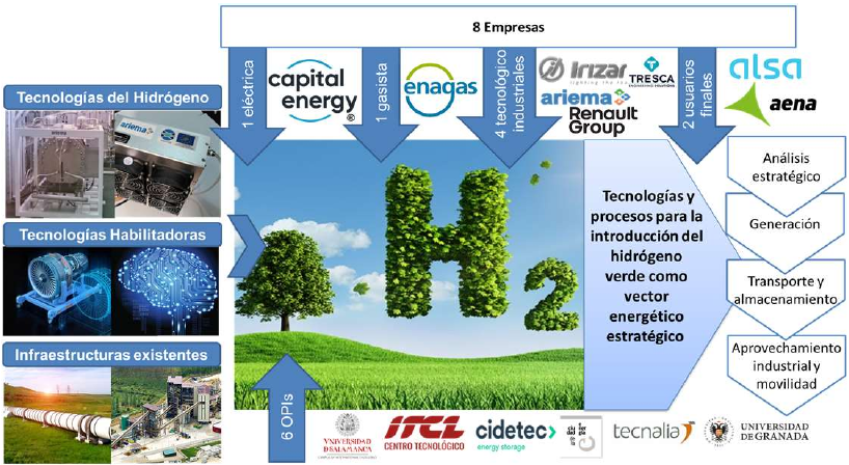
HYSTORENEW is a multi-sector and multidisciplinary R&D consortium, led by CAPITAL ENERGY, whose main objective is the research and development of an integrated set of technological solutions for the optimized and safe management of green hydrogen throughout its entire value chain in Spain. With a budget of €7.8 million to be implemented over 48 months, it seeks to accelerate the mass introduction of green hydrogen as a strategic energy vector for the decarbonization of the economy.
The consortium brings together eight key companies—covering everything from generation to consumption (CAPITAL ENERGY, ENAGAS, IRIZAR, AENA, ALSA, ARIEMA, RENAULT, and TRESCA)—and six research organizations (IPOs), ensuring a comprehensive and complementary approach to the hydrogen challenge.
Key areas of research include:
Strategic Analysis and Monitoring: Development of Artificial Intelligence (AI) and Digital Twins tools for optimal site and infrastructure selection, and satellite network surveillance (InSAR).
Generation and Storage: AI-based optimization of electrolyzer connections to renewable energy (RE) and the valorization of pure oxygen as a byproduct. It also investigates optimal conditions for underground storage and the use of liquid organic carriers (LOHCs).
Industrial and Mobility Uses: Research into the synthesis of synthetic fuels, the integration of H2 into industrial thermal processes, and the development of applications for ground transportation and large critical infrastructures, such as airports.
The competitive advantages expected to be obtained are significant: reduction of the analysis effort in project planning by up to 40−50%, reduction of investment and operating costs (CAPEX/OPEX) by up to 15%, and improvements in operational efficiency and safety of operations.
ALSA, as one of the two end users (along with AENA) and an urban and intercity transport operator, plays a crucial role in validating and developing the application of green hydrogen in metropolitan mobility.
His participation focuses on the Work Package "Production, Storage, and Intelligent Distribution of Renewable Hydrogen in Transportation" and "Proof of Concepts," leading research into renewable hydrogen for metropolitan bus transport operations.