
Mission
Repsol has set a goal of achieving between 0.7 and 1.2 GW of installed renewable hydrogen capacity by 2030, as part of its commitment to decarbonization and the energy transition.
Vision
Repsol's vision is that renewable hydrogen will be deployed initially to meet industrial demand and gradually replace the conventional hydrogen currently produced through gas reforming.
Project update – January 2026.
- The new plant to produce renewable hydrogen will require an investment of 292 million euros.
- The initiative has been recognized as an Important Project of Common European Interest (IPCEI) by the European Commission and will have the financial backing of the Government of Spain through NextGenerationEU funds from the Recovery, Transformation and Resilience Plan.
- The electrolyzer will have the capacity to produce up to 15,000 tons of renewable hydrogen per year, which will be used mainly in the Petronor refinery.
- With this new facility, Repsol and Petronor will contribute to the decarbonization of the industry, preventing the emission of up to 167,000 tons of CO2.2 every year.
- Repsol is the country's main producer and consumer of hydrogen and has a presence throughout the renewable hydrogen value chain.
Repsol is taking another step in its industrial decarbonization strategy through renewable hydrogen and will install its second large-scale electrolyzer at its Petronor refinery in Muskiz (Bizkaia). Last September, the company approved the construction of its first large electrolyzer, a 100-megawatt (MW) unit, in Cartagena.
The new 100 MW infrastructure will require an investment of 292 million euros to be commissioned in 2029. Recognized by the European Commission as an Important Project of Common European Interest (IPCEI), it will have the support of the Government of Spain and will receive 160 million euros through NextGenerationEU funds from the Recovery, Transformation and Resilience Plan.
The electrolyzer will have the capacity to produce up to 15,000 tons of renewable hydrogen annually, which will be used primarily in Petronor's own refinery processes. As part of the Basque Hydrogen Corridor, it will also supply renewable gas to the region's industry, driving its decarbonization with a key contribution: it will prevent the emission of up to 167,000 tons of CO₂ per year, equivalent to two-thirds of the electric vehicle fleet in Spain in 2024.
The project, which represents a major technological challenge due to its scale, will generate approximately 900 direct, indirect, and induced jobs during its various phases. Furthermore, it builds upon Petronor's existing progress in the development of renewable hydrogen: in 2023, it commissioned its first 2.5 MW electrolyzer. The 350 tons of renewable hydrogen it produces annually already supply the refinery and the building housing Petronor's offices in the Abanto Zierbena Technology Park in Biscay.
Also, in 2024 construction began in the port of Bilbao on a second 10 MW electrolyzer that will be commissioned in 2026 and will supply the synthetic fuels demonstration plant that Repsol is promoting together with Aramco.
Second large electrolyzer
Repsol leads hydrogen production and consumption on the Iberian Peninsula, accounting for 601,000 tons of national production and contributing 41,000 tons of European consumption. In September 2025, Repsol gave the green light to its first large-scale 100 MW electrolyzer, which will be installed at its Cartagena facility.
The new renewable hydrogen plant will soon be joined by the large electrolyzer in Tarragona, with a capacity of 150 MW. Like those in Cartagena and Petronor, it will primarily supply Repsol's industrial center. It is also expected to provide renewable hydrogen to the future Ecoplant—which will produce renewable methanol from municipal waste—and other local industries.

Initial project description
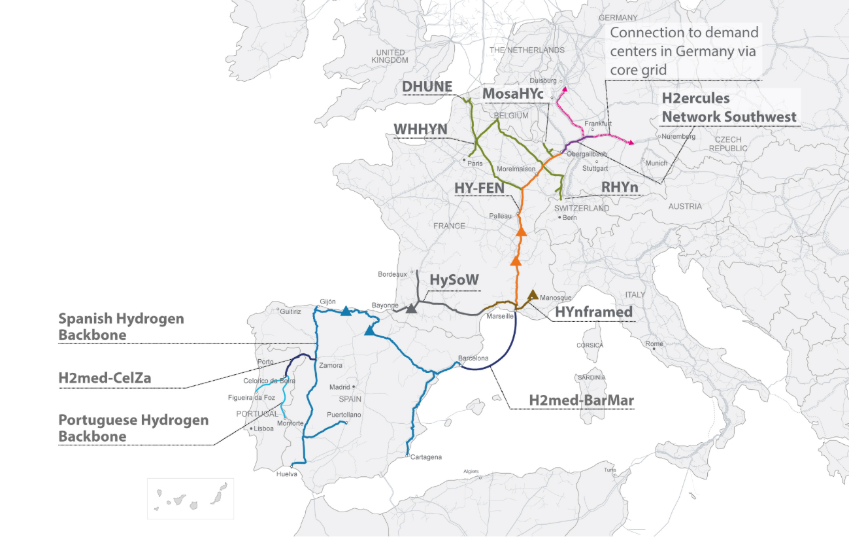
Petronor, subsidiary of the group Repsol, is leading one of the most ambitious renewable hydrogen projects in Spain with the construction of a 100 MW electrolyzer in the Biscayan municipality of Muskiz. This initiative has been recognized by the European Commission as an Important Project of Common European Interest (IPCEI), underscoring its strategic relevance for the development of a hydrogen economy on a continental scale. The project is part of the Basque Hydrogen Corridor (BH2C), an initiative that seeks to position the Basque Country as a leader in the production, distribution, and use of renewable hydrogen.
The electrolyzer will be integrated into the Port of Bilbao's Decarbonization Hub, a platform that brings together various industrial initiatives aimed at energy transition and emissions reduction in sectors that are difficult to electrify.
With the capacity to produce up to 15,000 tons of renewable hydrogen annually, this facility will prevent the emission of up to 167,000 tons of CO₂ per yearThe hydrogen generated will be used both in the Petronor refinery's industrial processes and for supplying third parties, especially local companies that require sustainable energy solutions for energy-intensive processes.
The 100 MW electrolyzer will be the largest of the three planned by Petronor in the region, along with a 2.5 MW electrolyzer already operational and a 10 MW electrolyzer currently under construction. Together, these facilities will generate 112.5 MW of clean energy, consolidating Repsol and Petronor as key players in the development of renewable hydrogen in northern Spain.
In addition to the electrolyzer, Petronor is developing complementary projects at the Port of Bilbao, such as a synthetic fuel demonstration plant, which will be operational in 2026, reinforcing the company's commitment to innovation and the circular economy.
This project not only represents a technological breakthrough, but also a model of public-private collaboration and territorial integration. It is part of Repsol and Petronor's strategy to lead the energy transition in industrial sectors that are difficult to electrify, and strengthens the Basque Country's role as a hub for clean energy innovation.
With this initiative, Repsol and Petronor They actively contribute to reducing emissions, promoting local economic development, and consolidating an industrial value chain around renewable hydrogen. It's an example of how traditional industry can transform to lead the shift toward a more sustainable energy model.